I was wondering how many public crash maps out there since it is so hard to see one for British Columbia and Canada. The data is not open like it is in other countries. Anyway, here is a list;
United Kingdom: http://www.bbc.com/news/uk-15975720
or http://crashmap.com/Search
USA: https://cdan.nhtsa.gov/GISMaps/STSI_MAP_Mobile.htm?1&USA&VAR1=1&41&-99&34,439&32,539&30,056&5
Jamaica: http://traffic-crashmap.monagis.com/
Michigan: Michigan tells you how to create your own crash map
www.michigan.gov/documents/mdot/TrafficCrashMapInstructions_530358_7.PDF
When you generate the map you can even click on the accident and see the police
report (less any personal information).
Virginia: https://www.treds.virginia.gov/Mapping/Map/CrashesByJurisdiction
New Mexico: http://tru.unm.edu/Crash-Maps/Multi-Year-Maps/index.html
Alberta: Highway 881 and 63. An interactive story about the accidents on these highways. A very impresive website. https://fatalities.safer63and881.com/
Edmonton: Can't find a interactive map but lots of reports at; https://www.edmonton.ca/transportation/traffic_safety/motor-vehicle-collisions.aspx
Maybe talking to people attending this conference about creating a public facing crashmap for British Columbia would be advantageous: http://www.carsp.ca/carsp-conference/carsp-conference-2018/
A very good ESRI Story Map on Analyzing traffic accidents in space and time
http://eath.maps.arcgis.com/apps/Cascade/index.html?appid=9a27635635c940539b96fb5ef954e4d5
Saturday, 7 April 2018

British Columbia Trauma Information
A very informative document on what Trauma Services BC is.

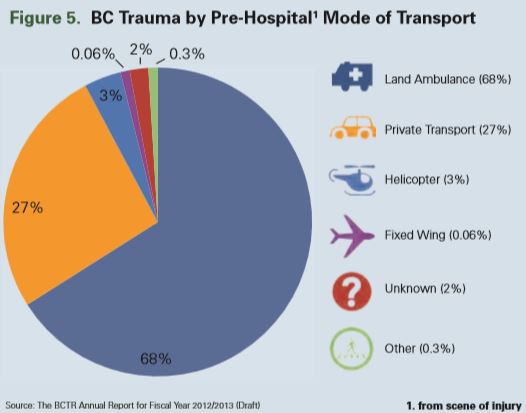

This research document is interesting regarding how geo trauma works;
http://caep.ca/sites/caep.ca/files/caep/files/can_geo_trauma_implications.pdf
This document provides for more recent research on rural patient transport in B.C.
https://www.divisionsbc.ca/CMSMedia/WebPageRevisions/PageRev-12516/Rural%20Patient%20Transport%20Report%20-%20FINAL.pdf
for example:

and more information on transport studies

Thursday, 5 April 2018
British Columbia - Traffic Collision Statistics
British Columbia Traffic Collision Data Research Notes
I am doing some research into British Columbia's traffic collision data and am being enlightened to a wealth of information available from various different locations. This blog will summarize some of that here;
A) ICBC compiles a list of summarized information and that is available at;
http://www.icbc.com/about-icbc/newsroom/Pages/Statistics.aspx
B) A look into where ICBC get's their data reveals a couple of places;
- The BC Gov Collision Information System
- The Police Traffic Accident System. The data from this is possibly available from;
https://www.injuryresearch.bc.ca/idot/traffic-accident-system/
C) A lot of information is available at;
https://www.injuryresearch.bc.ca/resources/injury-data-online-tool-idot/
D) Information on research via JIBC
http://www.jibc.ca/research
E) If you want to view collision information in Surrey you can just use their map
F) The Canada National Collision Database has the information but is missing location.
http://wwwapps2.tc.gc.ca/saf-sec-sur/7/ncdb-bndc/p.aspx?l=en
G) The USA has lots of information available. E.g.
https://cdan.nhtsa.gov/stsi.htm
A) ICBC compiles a list of summarized information and that is available at;
http://www.icbc.com/about-icbc/newsroom/Pages/Statistics.aspx
B) A look into where ICBC get's their data reveals a couple of places;
- The BC Gov Collision Information System
- The Police Traffic Accident System. The data from this is possibly available from;
https://www.injuryresearch.bc.ca/idot/traffic-accident-system/
C) A lot of information is available at;
https://www.injuryresearch.bc.ca/resources/injury-data-online-tool-idot/
D) Information on research via JIBC
http://www.jibc.ca/research
E) If you want to view collision information in Surrey you can just use their map
F) The Canada National Collision Database has the information but is missing location.
http://wwwapps2.tc.gc.ca/saf-sec-sur/7/ncdb-bndc/p.aspx?l=en
G) The USA has lots of information available. E.g.
https://cdan.nhtsa.gov/stsi.htm
Saturday, 24 March 2018
Wildfire terrain and broken leg - Lessons Learned
How a typical operation can go from routine to bad to worse and why you should always carry a secondary communications device whenever you are operating alone. Watch this video to see how a climb up a hill can result in a broken leg and then a mis-step in a helicopter landing can result in a more complicated extrication. Note: notice how they are utilizing a SKED stretcher.
https://www.nifc.gov/wfstar/modules/HF/libraryHF_DeerPark.html
https://www.nifc.gov/wfstar/modules/HF/libraryHF_DeerPark.html
Friday, 12 January 2018
Firefighter Station Gear: Cotton TShirts vs Polartec vs ??
So which TShirt is safer under your turnout? Cotton or PolarTec or ?
Traditionally firefighters have been issued standard cotton tshirts worth about $10 for their standard station wear and these are the tshirts that they practice in and wear under their turnouts.
Is there any benefit to other types of tshirts? This blog posts gives you some information in order to help make that decision.
There are numerous studies out there regarding this issue. You can check them out at;
NFPA 2112 Testing
Homeland Security Wildland Firefighter PPE Guide
You may want to avoid any underwear that is categorized as a thermoplastic. Check this out;
What to wear under your turnouts
Here are some excerpts from ArcFlashWear
Selection of the 'perfect' FR textile and/or fibre is a complex process. Each FR textile or fibre has particular properties which either provides benefits or shortcomings. Textile manufacturers blend fibres in an attempt to balance these individual properties to maximise a textile's performance. It is imperative that assessing Corporations be aware of each fibre's properties to ensure that garments selected meet the specific requirements of a given application. To read more about the individual properties of each fabric and/or fibre used in the construction of our FR Range, click here.
and
Traditionally firefighters have been issued standard cotton tshirts worth about $10 for their standard station wear and these are the tshirts that they practice in and wear under their turnouts.
Is there any benefit to other types of tshirts? This blog posts gives you some information in order to help make that decision.
There are numerous studies out there regarding this issue. You can check them out at;
NFPA 2112 Testing
Homeland Security Wildland Firefighter PPE Guide
You may want to avoid any underwear that is categorized as a thermoplastic. Check this out;
What to wear under your turnouts
Here are some excerpts from ArcFlashWear
Selection of the 'perfect' FR textile and/or fibre is a complex process. Each FR textile or fibre has particular properties which either provides benefits or shortcomings. Textile manufacturers blend fibres in an attempt to balance these individual properties to maximise a textile's performance. It is imperative that assessing Corporations be aware of each fibre's properties to ensure that garments selected meet the specific requirements of a given application. To read more about the individual properties of each fabric and/or fibre used in the construction of our FR Range, click here.
and
Hmm, thoughts of becoming a brand ambassador? http://www.tndwalphateam.com/
Monday, 8 January 2018
The 2016 Canadian Consenus guidelines for First Aid and CPR.
2016 Canadian Consensus guidelines for First Aid and CPR

There are a number of different first aid training providers in British Columbia. Does your training provider include anything from the 2016 Canadian Consensus guidelines for First Aid and CPR?
Read more about that at; 2016_Canadian_Consensus_Guidelines_First_Aid_CPR.pdf
Read more about that at; 2016_Canadian_Consensus_Guidelines_First_Aid_CPR.pdf
Spinal Precautions for First Responders
The times are a changing regarding Spinal Precautions in regards to better patient care but it is important to follow your level of training and protocols.
If you are curious what the current protocols are for Spinal Precautions according to BCAS then check it out at this site; https://bctg.bcas.ca/Condition/Principles/13
The medical principles in the BCAS document refer to an online course titled "Evolving Practices in Trauma Care". I did a bit of research and believe I have found that course offered at;
https://www.itrauma.org/education/itls-etrauma/
The ITLS has a document outlining their thoughts on the use of long backboards, etc. just for patient extrication. You can read about that at; https://www.itrauma.org/wp-content/uploads/2014/05/SMR-Resource-Document-FINAL.pdf
A really good article is "The Norwegian guidelines for the prehospital management of adult trauma patients with potential spinal injury". It states the following;
The vacuum mattress, while not rigid enough for extrication, is a useful transportation device. As vacuum is applied, the mattress moulds to the patient’s contours, minimising point pressure, making it more comfortable, less painful and, arguably, less likely to produce ulceration [73, 138–141]. The vacuum mattress has been shown to provide a similar, or superior, degree of stabilisation when compared to that of the backboard [132, 139, 140, 142].
According to the BCAS FR Intervention guidelines a FR is to provide manual stabilization and avoid any unnecessary movement. (at one higher level up, an EMR is to Immobilize patient following principles of spinal immobilization).
The BCAS recently issued an advisory on how they will be changing their treatment guidelines. This was done in the BCEHS Spinal Motion Restriction Briefing document.
If you are curious what the current protocols are for Spinal Precautions according to BCAS then check it out at this site; https://bctg.bcas.ca/Condition/Principles/13
The medical principles in the BCAS document refer to an online course titled "Evolving Practices in Trauma Care". I did a bit of research and believe I have found that course offered at;
https://www.itrauma.org/education/itls-etrauma/
The ITLS has a document outlining their thoughts on the use of long backboards, etc. just for patient extrication. You can read about that at; https://www.itrauma.org/wp-content/uploads/2014/05/SMR-Resource-Document-FINAL.pdf
A really good article is "The Norwegian guidelines for the prehospital management of adult trauma patients with potential spinal injury". It states the following;
The vacuum mattress, while not rigid enough for extrication, is a useful transportation device. As vacuum is applied, the mattress moulds to the patient’s contours, minimising point pressure, making it more comfortable, less painful and, arguably, less likely to produce ulceration [73, 138–141]. The vacuum mattress has been shown to provide a similar, or superior, degree of stabilisation when compared to that of the backboard [132, 139, 140, 142].
According to the BCAS FR Intervention guidelines a FR is to provide manual stabilization and avoid any unnecessary movement. (at one higher level up, an EMR is to Immobilize patient following principles of spinal immobilization).
The BCAS recently issued an advisory on how they will be changing their treatment guidelines. This was done in the BCEHS Spinal Motion Restriction Briefing document.
Subscribe to:
Posts (Atom)